Advertising

Showing posts with label economy. Show all posts

Tuesday, October 8, 2013

Minimum Wage: Over 60 Million Americans are Slaves in 2013

Ironically, finding the statistics of just how many Americans are earning minimum wage is near impossible. The closest I found was 2010 showing only 4.4 million. This is a bit askew considering one unconfirmed source speculated 30 million in 2006. What's the big secret? It would seem the number of Americans working for slave labor should be commonly posted Internet knowledge. It should be right up there beside our gross national debt and the Kardashians.

Everyone I know earns minimum wage. That's right, I said it. My employer earns more than I do but we don't revolve in the same circles. So perhaps it's time for your favorite naughty writer to update the system. Perhaps the Internet moguls let this tidbit of vital information slip their busy agendas. By my count, there are roughly 320 million United States citizens in America with an estimated 50 - 70 million earning minimum wage. This statistic is a highly speculative shot in the dark. I searched well over 100 online sources and found this to be a highly guarded statistic. So perhaps we should try another approach. Let’s rename this article and call it "Death of a Paycheck". Or, we can call it "Definition of an American Slave". Take your pick, I'm good either way.

Merriam Webster defines Slavery as “drudgery, toil and submission to a dominating influence. The state of a person who is a chattel of another.” The closest representation of a slave in America I can remember was before the Civil War. Slaves were provided shelter, food and water and basic clothing in return for labor. They were considered the property of the plantation owners. According to history, slavery was abolished in America in December of 1865.

I took my own paycheck and a calculator to do some figuring. Based upon my average taxes and basic living requirements, I wanted to see if I qualified to be a modern day slave in America. Taxable Monthly Gross Income for 160 hours x $7.25 (Minimum Wage) = $1160.00

Federal Withholdings are 10% of gross income. . 10 x $1160 = $116 - $1160 = $1040
State Withholdings are 3% of gross income. . 03 x $1160 = $34.8 - $1040 = $1005. 2
7% Sales tax comes out of every dollar spent. . 07 x $1005. 2 = $70.35 - $1005. 2 = $934.85
Our property tax monthly is $43.33 - 934.85 = $891.52 (Tack on $300-$1000 if you rent).
Banking Fees: $5.00 - $891.52 = $886.52 (A simple checking account is required to even cash your check.)
Mandatory liability insurance: Average is $114.52 monthly. $114.52 - $886.52 = $772.00
Car Tag: My tag was $249.96 / 12 months = $20.83 monthly. $20.83 - $772.00 = $751.17
Power bill: average is $150.00 - $751.17 = $601.17 (Don't try to leave it off. The power company will come and literally saw your pole down.)
Water/Sewer: $25.00 - $601.17 = $576.17
Gasoline: $75.00 x 4 weeks = $300.00 - $576.17 = $276.17. (If you pay rent you are now a starving slave. You require food stamps to survive.)
Groceries: (1 Person) $160.00 - $276.17 = $116.17
Phone Service: $42.33 - $116.17 = $73.84 (A phone is required by most employers.)
Amenities: $73.84+ - $73.84 = Debt (Amenities include soap, shampoo, toilet paper, washing powder and such for the month.)

There you have it. I have worked full time at minimum wage for a whole month. I earned just enough to pay for shelter, food, and transportation costs to and from work. I don't require clothes because I have a uniform. Raising my minimum wage will not help me. The basic costs of living will simply rise along with it. I earned nothing for my labor. I am the definition of a modern day slave according to Merriam Webster. You should try working 160 hours a month and still getting nothing if you think being unemployed is tough.

Sources:

Our Coffee Addiction Helps Struggling Economies

Considering I do most of my writing at a coffee shop, how could I not write about World Coffee Week? For me and many others, coffee has become more than a morning eye opener or welcomed relief after a hangover. It has become a vital part of our life.

How many times have we used coffee as an ice breaker to sit with someone we are interested in? It’s not as big of a commitment to ask someone for coffee as it is for a first date. If there is a spark between you then inviting your interest to have a cup of coffee is the ideal way to get to know each other better. But coffee has played a far greater role in connecting people. Coffee has connected us across the globe.

Each Monday a truck delivers coffee to our small book store and coffee shop. I have come to be among the first in line for the freshest cup of my favorite brew. Our coffee is sealed air tight and I probably could not discern a week old coffee bean from one just picked from the tree. But I am not alone in this long line each Monday morning.

Our coffee actually arrives at the distributor in burlap sacks. It comes from El Salvador, Guatemala and Colombia just to name a few. Our coffee shop is particularly popular because the chain has buyers that travel the world visiting coffee farms and decide which beans the chain will buy. We may not be capable of discerning a bean picked today from one sealed air tight a week ago. But we can definitely discern our shop coffee from that sold in the grocery stores.

Buyers know the higher the altitudes and warmer the climate the better quality of the coffee bean. For this reason the tropics are the best suited to grow the highest quality coffee. Our coffee comes to us from across Latin America, Africa and Southeast Asia. Coffee connects these typically poor countries with the world and sustains their economy. Global coffee bean exports can infuse billions annually into these struggling regions of the world.

It would seem that being a coffee buyer is among the top careers to have. One gets to travel the world and visit places like Ethiopia. The landscape in the high altitudes of Southwestern Ethiopia is a lush misty green tropical climate. But along with scenic beauty, a buyer also sees how desperately these places in the world depend upon the coffee market.

These small coffee farms do not constitute the total for coffee production. Our specialty coffee often comes from these places but 40% of our coffee comes from huge farms in Brazil.
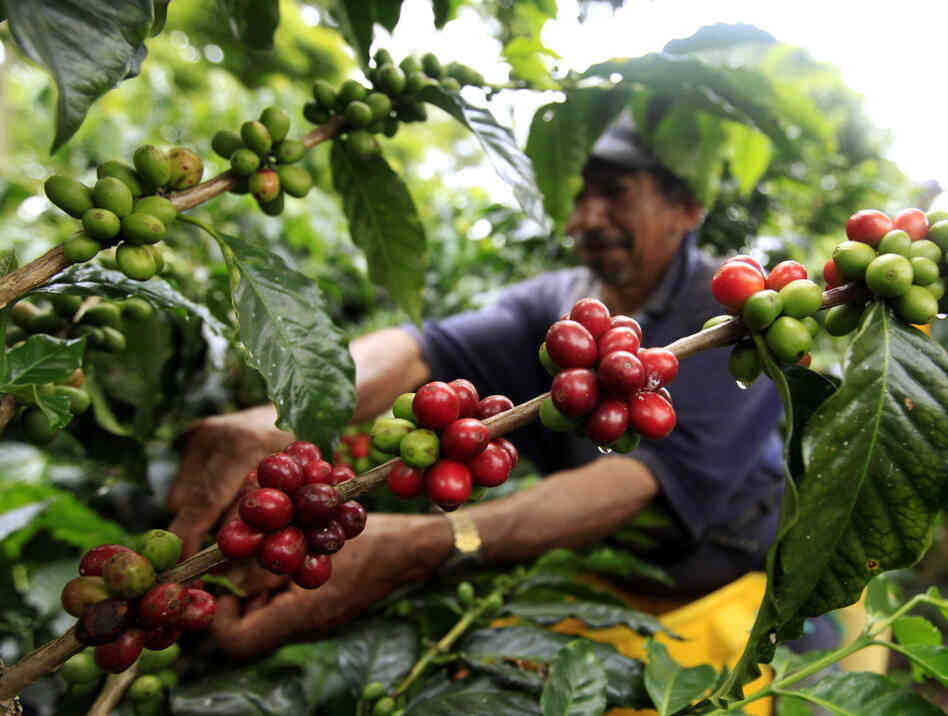
The coffee bean actually grows within a coffee fruit. In Brazil machines strip the fruit from the trees and harvest the bean inside. These farms span to the horizon resembling the farms we have here in America. This is typically your canned coffee found in grocery stores. The coffee trees on these farms are not in higher altitudes and have no shade provided by taller trees. As a result, the beans are smaller and are of lesser quality than specialty beans.

The second largest producer of coffee is Vietnam. Robusta (Coffea canephora) is a fast growing, high yield species of coffee tree grown by Vietnamese farmers. The robusta coffee trees produce big crops but are bitter in taste. The robusta beans are ground up and blended with grinds of other types of coffee and are used for our canned coffee. Specialty coffee buyers avoid buying from the Robusta coffee farms.

Our coffee comes a very long way to reach our tables. It warms us, wakes us up and even helps us connect with new people. As a commodity, coffee connects struggling economies around the world survive. So enjoy a cup of coffee and do your part to help the world!

Sources/Resources
Previously Posted on FullofKnowlege.com

Monday, October 7, 2013

Sin is Big Business

It doesn't matter how poor we are or how dire the economy, some things are recession proof. Time and again, the research fluctuates slightly but tells the same story. Sin sells and it even has its own tax classification as a levy weighed upon activities society deems undesirable. As we wade through another year of tough times we examine how sin is doing in today's economy and look at some of the reasons why it remains resilient.

As the economy declines, jobs become scarcer and people's lives become more desperate. Overwhelmed by their situations people who can not afford therapy or self medicate with the only legal substance available to them. It has been proven that the overall sales of alcohol actually rise as the economy declines. During the prohibition era alcohol was deemed a social menace and made illegal. It wasn't long before the black market for alcohol developed which vastly increased the sales and distribution of alcohol, resulting in a sharp increase in crime and violence. The same black market trend seems to be occurring with tobacco today.

Even with the across the board tax increases placed upon tobacco products, this industry continues to thrive seemingly unaffected profit wise by the levy. Tobacco has a mild euphoric effect that calms the smoker thus reducing stress. But the overall adverse effects of tobacco use far outweigh this calming effect. Each year thousands die due to illnesses directly related to their tobacco use. Many more thousands are disabled as a result. Legislation, increased taxes, health warnings and even laws prohibiting smoking inside or near businesses have done little to reduce the use of tobacco. Even as experts report that tobacco sales are in decline, it does not account for the increasing black market for tobacco products that is developing as a result of the tax hikes.

Sex sells. It's a little known fact that the 108 billion dollar sex industry far overshadows the illegal profits of cocaine which earns a meager 70 billion. The sex industry includes online porn, magazine and video sales, prostitution/escorts, strip clubs and adult novelty products to just name a few. The selling of sex has become so prevalent on the internet that it is hardly even noticed anymore. It is completely accessible to anyone and everyone even without searching for it. As a nation, in only a decade, our children have gone from having virtually no access to hard core porn to becoming so saturated by sex advertising they are numb to it.
On a side note, a little known trend is developing on the social networks still too new to have been given a colorful cultural label. It is sometimes referred to as the "face trade" associating it specifically with Facebook, but occurs on any social media. Escorts post provocative images of themselves on their social media page and soon they have developed a large list of potential clients. Over the course of conversing with the escort, a meeting is arranged and the nature of that meeting is discretely made known.

Perhaps the most disturbing trend is the increase in firearm sales. As the economy declines people become more paranoid and fearful of others. They see crime increasing as those unable or unwilling to seek work resort to criminal means. Firearms sales increase as people arm themselves for protection. Those who arm themselves with criminal intent may have prior records preventing them from purchasing firearms themselves, but can typically acquire weapons and ammunition from an extensive black market for weapons. In fact, the practice of purchasing firearms legitimately and then reselling it for profit to those who can not legally obtain them is a lucrative criminal market. For this reason, laws recently passed now hold the registered purchaser accountable as well as the perpetrator when a weapon is used in a crime.
Sources:

Friday, October 4, 2013

Economy: Are We Prepared for the End of the World?

Innovations throughout history have brought about the end of life as we know it and we began life anew. As we stand on the brink of a new age are we prepared?
No. I have not gone apocalyptic and will not be donning my billboard to walk the street announcing the "The End Is Near!" But the end of our way of life could, in fact, be nearing the end of its era.

We learned from history that our civilization has evolved as the result of certain innovations that changed the way we lived. These innovations marked the end of an age and the new beginning of another. As progress did its work, those that could not adapt found themselves leading the world one day and struggling to survive the next.

Throughout history the innovations that we mark as defining moments are classified as the Stone age, Bronze age, Iron age, Age of Invention (Agricultural age), and the Industrial Revolution age. Those that mastered the defining innovations of each age rose quickly to dominance over those that could not. And today, we are seeing history repeating itself. Today, the face of our civilization is evolving so rapidly that we have three defining and life altering ages materializing at once, Technology age, Information age, and Space age.

Today, the value of human thought is not only a sellable commodity but is the engine that is effectively tolling the bell for the previous Industrial Age. As information is pooled worldwide, transformed into ideas, and molded into technology at an astronomical rate, those that still hold onto the increasingly outdated Age of Industrialism must adapt or face extinction.

Teenagers are creating applications for our computers, iPads and smart phones that make our everyday lives more efficient and productive while simultaneously rendering entire production lines obsolete. Eesha Khare and Henry Lin created a supercapacitor that is said to have the ability to charge batteries within seconds, and they haven't even graduated high school. This supercapacitor is wonderful news for those of us spending a small fortune on batteries, but not so good news if your job is on an assembly line making batteries.

Governments and government contractors enjoyed sole access to space for years after innovations in rocket fueled propulsion, before Sir. Richard Branson, CEO of Virgin Atlantic looked into the heavens and said, "I want to go there." Today Branson has built an air/spacecraft that can taxi from the surface of the earth and fly to the edge of space and land again. Branson promises that soon, we will be able to make reservations to resort hotels orbiting the earth.

As our economists wrestle to solve the mystery of the collapsing job markets and entire governments are crumbling into economic ruin, perhaps they should look to the world around them and ask themselves if the Industrial Age that sustained them so well yesterday will be obsolete tomorrow?

People are dropping out of the job markets. They are more educated, connected, and free to share ideas and collaborate in the creation of technology so amazing it hinges on the verge of science fiction. As people find more work opportunities available online they are less reliant upon the typical job market. As more people learn their own ideas, personal talents and ingenuity have value to the world the less they want to work for someone else.

Together, people are quickly bringing in a new age where the typical employer/employee relationship is becoming increasingly outdated. Replacing this outdated business model is a more creative and efficient partnership between talented people and corporations equally invested in their ideas and products. Out with the old and in with the new has been the way of things repeatedly throughout our history as a civilization.

I end this article with an appropriate medieval end to this foreboding prophecy. Lay down the old ways of the previous age and embrace the new. I say, the end is near.... Repent! The value of your ideas and talents are worth more to the world than the burgers you flip!

Sources/Resources
Previously Posted on FullofKnowlege.com


Thursday, October 3, 2013

Economy Trade: True Definition of Trade Based Economy

While sitting in church before the pastor was to take the podium, members of the congregation discussed the state of our economy. My generation graduating college has learned the opportunities in our fields of study simply aren’t available. And let’s call it for what it is, economic times such as ours create an “employer’s market.” Even if you are fortunate enough to get a job in your chosen field it will typically be a drastic cut in expected salary and benefits, as companies struggle to keep operational costs down. Productivity, innovation and overall prosperity suffer as a result. Economists predict the situation will get worse before it gets better and have no real estimate of when substantial economic growth will happen. For us, this is not encouraging news. This was the topic on our minds at church and on the minds of everyone across our nation.

I have been told for years by my elders that we, the younger generation, have had it too easy. We have, as a society, forgotten what a real trade based economic system means. Again, this term was mentioned by our church elders. The term trade based economy seemed generic enough, surely I had heard of it in college and written an essay or something on it. I quickly start to click away on my smart phone to look it up but was immediately informed by my uncle, that I would not learn about trade based economy from my tiny magic toy. Feeling more than slightly belittled, I put away my tiny magic toy and listened as my uncle and grandfather explained their definition of the trade based economy to the church members. As they spoke in the rear of our small church, the entire congregation formed around them.

Paraphrasing, trade based economy is defined very differently by people who are starving than it is by economists. When I think of the great depression I see the image of a Nebraska farm house that appears as if was built in the middle of a desert with tumbleweeds rolling by. I thought of my tiny magic toy as well as all of my tiny magic things and shuddered at the thought of no longer having them. Without rehashing the history books, the great depression was simply the closest America has ever come to becoming a third world country. Our elders explained that even with terrorism, war and environmental challenges; economic collapse has always been America’s only natural predator. And it has stalked us like a hungry beast since we became a nation.

The people of this time did not survive by crunching numbers, analyzing stock market trends or even borrowing from China. They bonded together as a community and relied upon their own skills and talents to help each other. I looked behind me to the long table in the foyer covered with farm fresh produce, eggs, my mother’s homemade quilts and various tools and small appliances. I began to understand.

Countless times that year I had placed my name in a book that sat on a stand at the doorway to volunteer my time to the church. I helped repair roofs, deliver home cooked meals to the elderly in deep rural areas, and cut more grass than I ever had as a kid. I felt I had a real grasp of trade based economy. Then I thought of hurricane Katrina.

Katrina cut a deep scar across communities, cities and townships from the coast and beyond where I live in Mississippi. Even now, eight years later, those scars can still be seen. Many people lost their lives and many of the lost were never found.

The people of my little church came together as a community to help others devastated by the storm with humility and smiling faces. What occurred to me as we listened intently to our elders was that during that time, although hard hit, none of us were without clean water, fresh food, or electricity. The foyer of our little church was stacked to the ceiling with supplies. I had signed the list to volunteer to deliver the food, water and generators to each of the homes on a specified route. The only thing we asked in return was anything that family could spare to help their neighbor even if all they could spare was their time.

We soon realized all of the pastor’s time had gone by. He had sat among us as well to listen to the elders speak. After our unique church service, we all hugged saying our farewells and went our separate ways. I realized then that we would be okay. As the economists crunch their numbers and our government weans itself off foreign financing we, as a community, will survive as we always have. I can’t help but to wonder how different our nation would be if real trade based economy as defined by our elders was the official economic system.

Sources/Resources